
Idaho switched things up last year. For a long time, nonresident general deer and elk tags were sold first-come, first-served. Then Idaho Fish and Game moved them to a drawing. The first one ran December 5–15, 2025, for 2026 tags. Nobody really knew what the odds would look like, because there was no prior draw to go by.
Now we finally have the data. This year’s window is December 5–15, 2026, for 2027 tags — Idaho’s second annual nonresident tag draw. The question is how to use that year’s worth of results to make the best decision.
What happened last year
Idaho’s first nonresident general deer and elk tag drawing ran December 5–15, 2025, for 2026 tags. IDFG’s official odds report says every nonresident general elk tag, and every regular and white-tailed deer tag, was drawn in that first period.
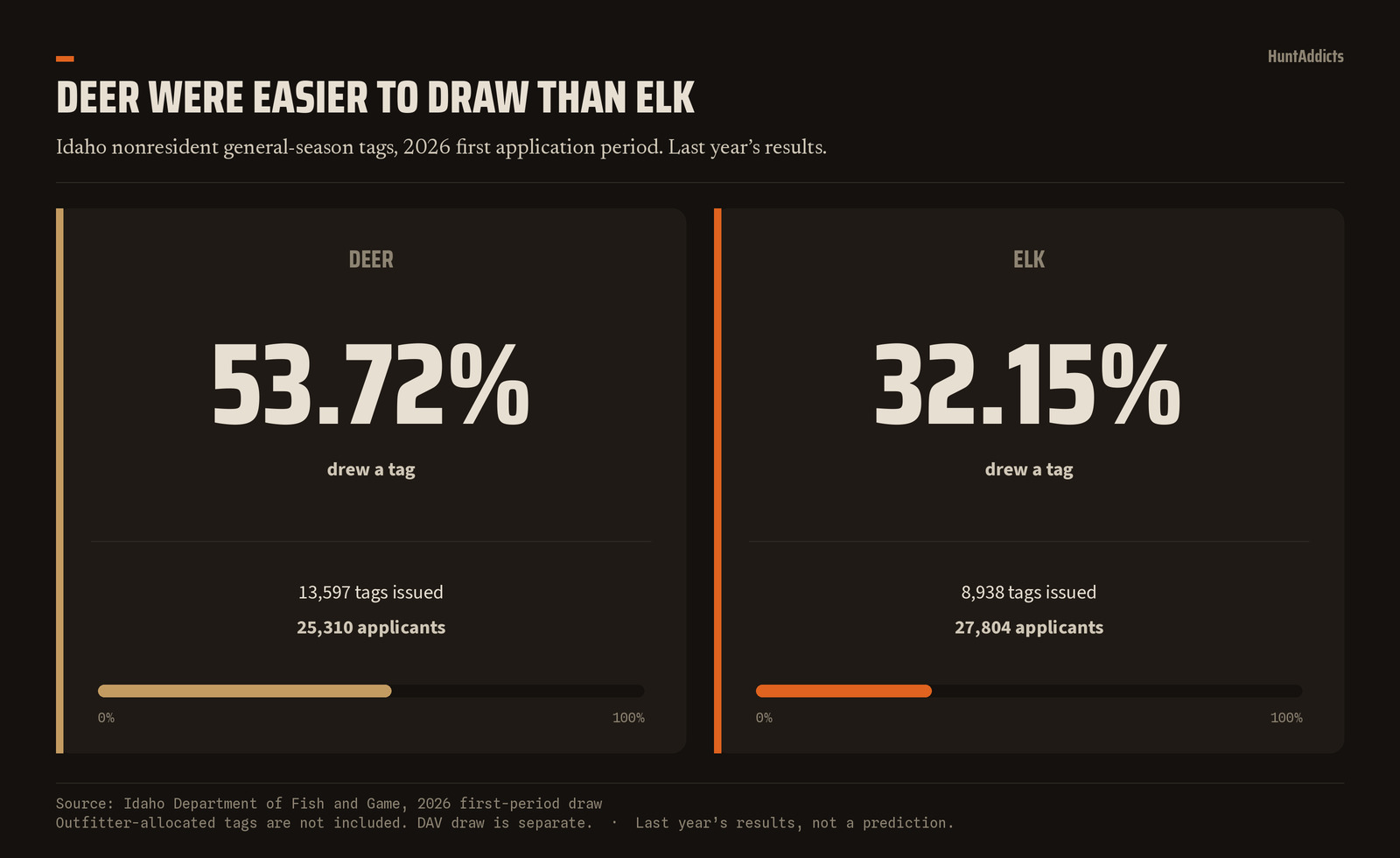
Deer were easier to draw than elk. IDFG reports that 53.72% of regular and white-tailed deer applicants drew, and 32.15% of elk applicants did — 13,597 deer tags issued to 25,310 applicants, and 8,938 elk tags issued to 27,804 applicants, in IDFG’s first-period tables, which exclude outfitter tags. The separate DAV draw was tighter: 10.16% for elk (300 tags, 2,953 applicants) and 17.56% for deer (500 tags, 2,847 applicants).
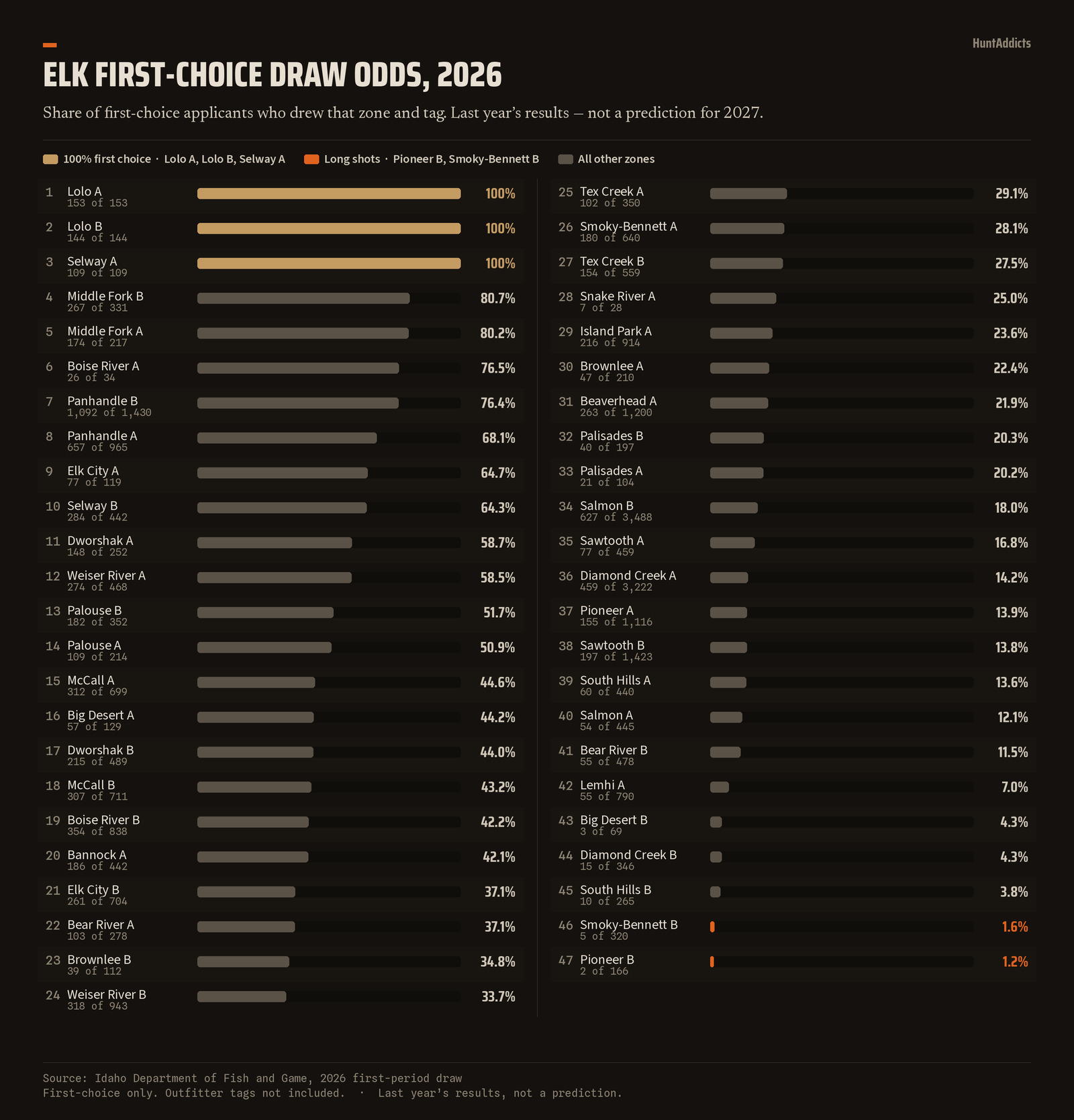
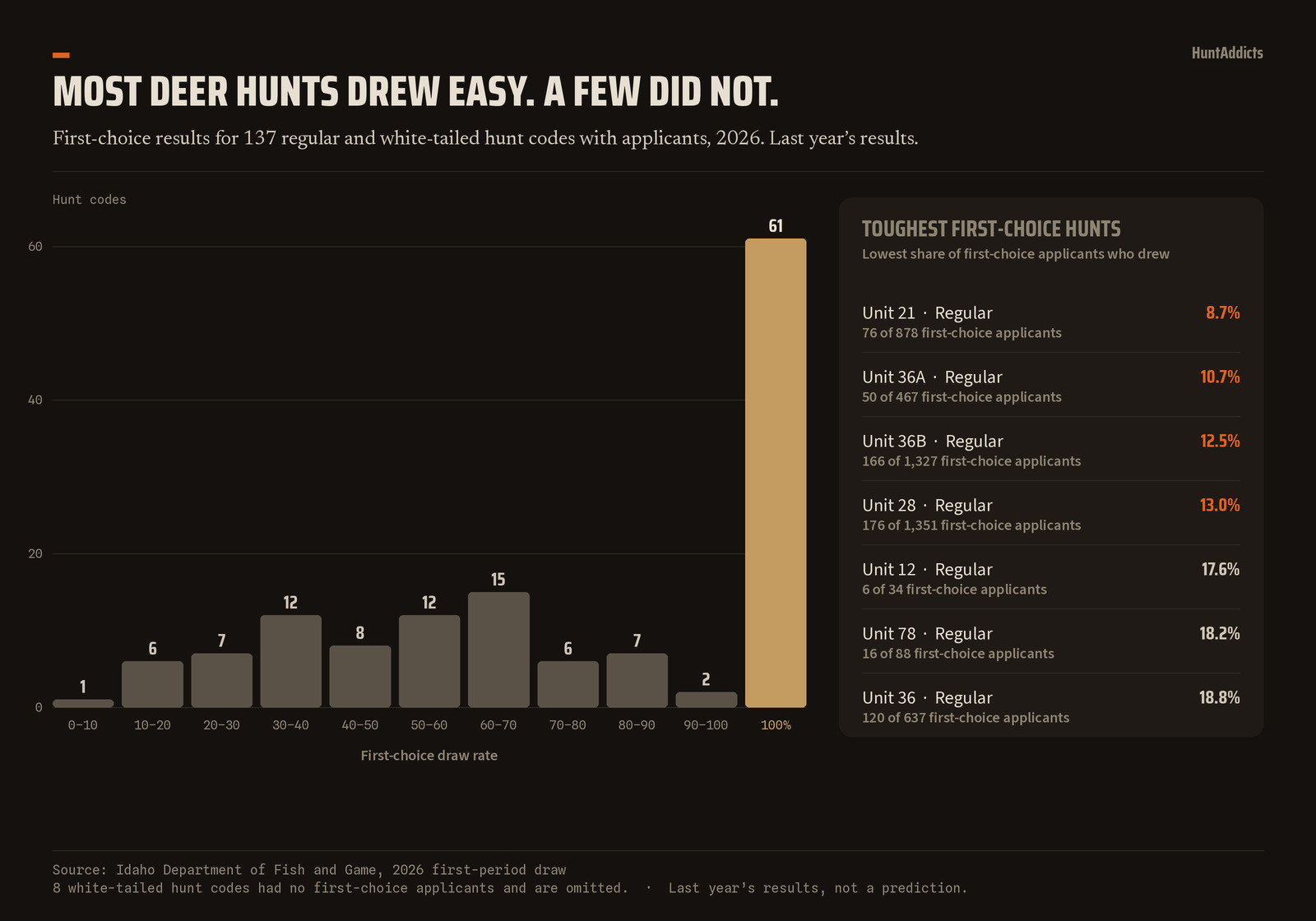
The elk list was uneven. Only Lolo A, Lolo B, and Selway A came back at 100% on the first choice. Every elk tag was awarded on a first or second choice. Pioneer B was 1.2% (2 tags, 166 first-choice applicants) and Smoky-Bennett B was 1.6% (5 tags, 320 applicants). On deer, 61 of 145 hunt codes were 100% on the first choice; regular-deer units 21, 28, 36A, and 36B came in under 15%. Some deer units show fewer tags drawn than the unit quota because the 15,500 statewide cap can be hit first. All deer tags were awarded on a first, second, or third choice.
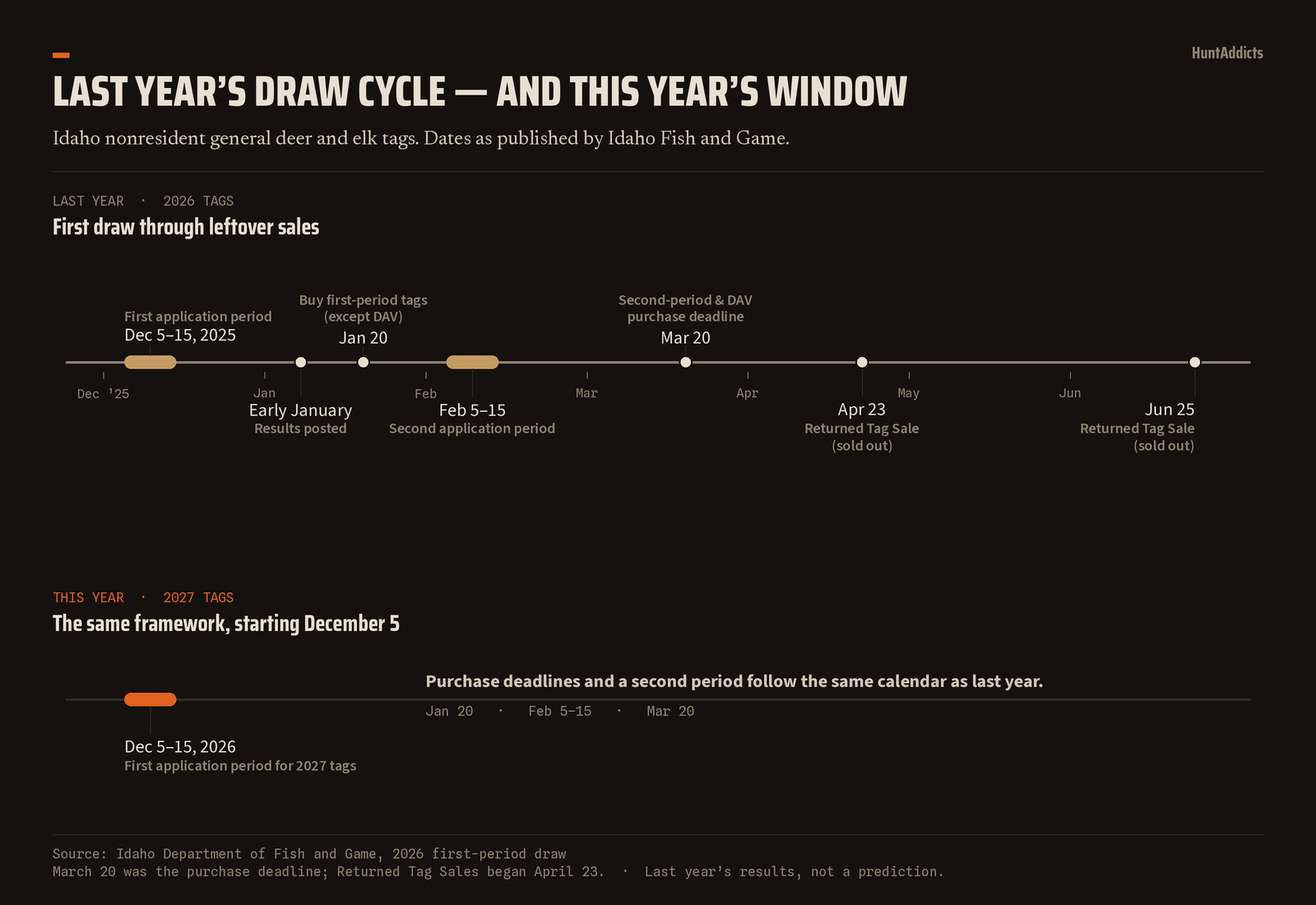
The February 5–15 second drawing was for tags first-period winners didn’t buy by January 20. IDFG posted those results on February 24 and did not publish a second-period odds table. Unclaimed tags after March 20 went to Returned Tag Sales, first-come, first-served, starting at 10 a.m. mountain time. The April 23 and June 25 sales of nonresident general deer and elk tags, including DAV, sold out during the sale. The August 6 sale’s nonresident/resident elk leftovers were not marked sold out until September 8.
IDFG says this year’s drawing uses the same framework. Statewide caps are unchanged at 15,500 deer and 12,815 elk, including outfitter set-asides. The main new wrinkle is that 2027 is a season-setting year, so seasons won’t be set until March — after the December application window closes.
Why Idaho is a great choice to apply
Idaho is a strong place to put in, especially if you’re tired of point systems. There’s no preference or bonus points, and no point creep. Everybody who applies has the same chance.
That also means you can really choose the kind of application you want. If you want a tag that’s about as close to a sure thing as last year got, look at the general elk tags that came back at 100% in our free Draw Odds Edge tool: the Lolo Zone A and B tags, and the Selway Zone A tag. Lolo A had 216 tags and 153 applicants; Lolo B had 222 tags and 144 applicants; Selway A had 254 tags and 109 applicants.
You can also shoot for the moon. On the same list, the Pioneer Zone general B tag came back at 1.2% (2 tags, 166 applicants), and the Smoky-Bennett Zone general B tag at 1.6% (5 tags, 320 applicants). Those are last year’s results, not a guarantee for 2027, and a low percentage is not the same thing as a hunt you can access or want to make.
We expect the odds to change and settle over the next couple of years, as more hunters figure out the new system. That’s all the more reason to make an informed decision instead of a guess.
The steps and dates
Buy the license first, then apply, then — if you draw — buy the tag on time. IDFG will not take payments or applications for this draw over the phone. Apply online at GoOutdoorsIdaho.com, or at a license vendor or IDFG office.
The adult nonresident hunting license is currently $185, plus a $10 Access/Depredation fee on annual adult licenses. That license is nonrefundable if you don’t draw, and neither is the $18 application fee per species. If you do draw, the tag is a separate purchase. As of November 23, 2026, IDFG lists the adult nonresident deer tag at $351.75 and the adult nonresident elk tag at $651.75.
Here’s the timeline IDFG has published for 2027 tags:
- December 1, 2026: 2027 licenses go on sale.
- December 5–15, 2026: First application period for the nonresident and Disabled American Veteran (DAV) draw.
- December 12, 2026, at 2 p.m.: If IDFG staff need to add hunter education to your profile, get the paperwork in by this time. Hunters born after 1974 must have hunter education on file before buying a license and tags; archery hunters also need archery certification. After that cutoff, you can add it yourself in your GoOutdoorsIdaho profile.
- Early January 2027: First-draw results are posted in your GoOutdoorsIdaho profile.
- January 20, 2027: Deadline to buy a tag from the first draw (except DAV). Unclaimed tags move into the second period.
- February 5–15, 2027: Second application period, nonresident draw only. If you drew a species in the first period, you cannot apply for that species again, even if you don’t claim the tag. Results come in early March, and those tags — plus all DAV tags — must be purchased by March 20. There is no second DAV period.
This is a season-setting year. The Commission sets 2027 seasons in March, and the 2027 brochure comes out in April, so treat the 2026 brochure as a guide only. Use the 2027 Nonresident Supplement for hunt codes when you apply.
You can submit one deer application and one elk application, with up to five hunt choices on each. Regular and white-tailed deer go on the same application. Groups of up to four count as one application and only draw if there are tags left for everyone. This December draw is for general-season tags, not controlled hunts. Controlled deer, elk, and pronghorn applications typically run May 1–June 5, and drawing a general tag does not stop you from applying in the spring.
Common mistakes
- Waiting on the license. You can’t apply without a 2027 hunting license, valid for big game. Licenses go on sale December 1, and hunter education should be on file before you buy one.
- Treating this as the controlled-hunt draw. December is the general-tag drawing. Controlled deer and elk hunts are a separate application later in the year.
- Leaving choices blank, or listing a hunt you wouldn’t hunt. You get up to five choices. Use them, and only list hunts you would claim.
- Applying as a group of four on a tight quota. The group only draws if there are tags left for every member.
- Missing January 20. If you don’t buy a first-period tag by that date, it’s forfeited, and you can’t apply for that species in February.
- Expecting a refund. License and application fees are not refunded if you are unsuccessful. The license can still be used for other opportunities, including controlled-hunt applications.
- Treating last year’s odds as a lock. They’re last year’s results, and 2027 seasons won’t be set until March. Confirm the current rules with IDFG before you apply, and again before you hunt.
Try the new tool — and get a second set of eyes if you want one
If you’re trying to decide where to apply in Idaho this year, start with the free Draw Odds Edge tool. Pick the state, the species, and whether you’re a nonresident, then work through the list. It’s new this year, and you don’t need an account.
If you want help thinking it through, you can schedule a 1-on-1 strategy call for $59. It’s 60 minutes by Zoom or phone, and it includes a recap by email.
HuntQuarters is the premium arm of HuntAddicts.com. If you want to go further than the free tool, the annual membership is $149 a year and includes the member version of draw odds — hunter success, herd and trophy data, and point-level odds in the states that use points.
Always confirm dates, fees, hunt codes, and regulations with Idaho Fish and Game before you apply. The agency’s current page is the one that counts.
Sources
Verified November 23, 2026.
- IDFG: Here’s how to navigate (and successfully apply for) Idaho’s second annual nonresident tag draw (November 10, 2026)
- IDFG Nonresident Deer and Elk Tags
- 2027 Nonresident Supplement for General Season Deer and Elk (PDF)
- IDFG: Nonresident General Season Deer & Elk Tag Draw Odds Description (2026, 1st application period) (PDF)
- IDFG License, Tag, and Permit Costs – Nonresidents
- IDFG Returned Tag Sales
- IDFG Controlled Hunt Application Information
